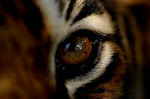
I have now come to the point where I can no longer skirt the issue. I have had so much to say about Life of Pi up until this point that I could tuck this in the back of my mind and spew out everything else but. The time has come, my friends, for me to take the plunge and plumb the depths in which the greatest social commentary of this novel lies: religion. Oh how carefully I have avoided this until now. Pourquoi? Parce-que discussing a theme so vast, so ancient, and so boundless in it's manifestations as religion is asking for trouble. Indeed, humanity's great (and yet so minuscule) history is pock-marked by the troubles of religion. And that is not in anyway meant to sound as if I believe that religion is the cause of, or is to blame for the world's trials and tribulations, if you'll excuse the expression, but we can not deny the profound and most penetrating influence of humans' religion (and lack thereof) on our existence. Unfortunately for the atheists of the world, religion, in this most general sense, affects every aspect of human life: social, cultural, philosophical, economical, political, psychological and ecumenical.
Most normal human beings would be lucky to be able to recite that sentence with appropriate diction much less begin to dissect these fundamental aspects of humanity in terms of their religion. However, there is hope for my apologia! Fear not!
Humanity is so indescribably blessed by the existence of Individuals. More to the point, I am blessed with one in particular: Pi Patel.
...to be continued

Just A Thought
Yes, this is what this is- a passing thought. I was sitting on my couch, my eyes wandering absentmindedly across the rows upon rows of books on our shelves when they came across one of my very favourite comic strips: 'Calvin and Hobbes'. Now, personally, I find that when my mind is absent is when I do my most prolific thinking- either when staring off into nothingness or being in that place halfway between awake and asleep does this usually occur. One of the consequences of this unguarded thinking is that you are able to put ideas together that simply would not be coagulated in any normal state of mind. However, the mind is a perpendicular universe, and we must embrace it.
And so it came to pass that the roles of Calvin and Hobbes were reversed in the context of my 4UAP novel Life of Pi: Pi Patel played the role of Hobbes (the reflective, introspective inquisitor) while Richard Parker (the tiger aboard the life boat with Pi) embodied Calvin's persona of the selfish, aggressive, and ultimately helpless brooder.
I would be most indescribably grateful if people would be so kind as to post their own comments on this particular stream of semi-consciousness; I would be most interested to know. I have a strong feeling I will be adding to this particular posting, so stay tuned!
And so it came to pass that the roles of Calvin and Hobbes were reversed in the context of my 4UAP novel Life of Pi: Pi Patel played the role of Hobbes (the reflective, introspective inquisitor) while Richard Parker (the tiger aboard the life boat with Pi) embodied Calvin's persona of the selfish, aggressive, and ultimately helpless brooder.
I would be most indescribably grateful if people would be so kind as to post their own comments on this particular stream of semi-consciousness; I would be most interested to know. I have a strong feeling I will be adding to this particular posting, so stay tuned!
Richard Parker
I enjoy wondering how and why Richard Parker does not kill Pi.
Through Pi thus far we have come to an understanding of animals that surpasses our, or at least my original thoughts pertaining to wildlife. Despite my naturalist aspirations, I'm obligated to admit that I am more often than not indifferent to zoos.
On the other end of the spectrum is Pi, who has such an extremely visceral connection with animals. His experiences, i.e. his upbringing at a zoo, have no doubt sculpted this predominant aspect of his personality. Because of his panoramic reservoir of experience and memory of the Pondicherry Zoo, it may be suggested that his understanding of animals is much truer than the average visitor's.
Now back to my initial muse: my contemplation of a Richard Parker's certain abstinence. Could it be that he, by some innate (or perhaps divine) intuition, recognizes Pi and his unusual pathos? In accordance with some dogma of tiger predation, he does not attack. One person might suggest in a benumbed fashion that this is simply because Richard Parker was probably fed a hefty meal before being loaded onto the ship. Because Bengal Tigers only eat maybe once every week or week and a half, he felt no inclination to kill at a moment when it wasn't necessary; Tigers are frugal.
I much prefer to extrapolate the idea of intuition in the animal- especially since Pi has taught us so much about the inner sanctum that is animal captivity. As a side note, Pi firmly believes and supports that animals are infinitely more content within the safe, dependable enclosures of zoos, as they are not endangered by the elements, food chain, droughts, poachers...the list goes on with almost quirky but articulate zeal.
Through Pi thus far we have come to an understanding of animals that surpasses our, or at least my original thoughts pertaining to wildlife. Despite my naturalist aspirations, I'm obligated to admit that I am more often than not indifferent to zoos.
On the other end of the spectrum is Pi, who has such an extremely visceral connection with animals. His experiences, i.e. his upbringing at a zoo, have no doubt sculpted this predominant aspect of his personality. Because of his panoramic reservoir of experience and memory of the Pondicherry Zoo, it may be suggested that his understanding of animals is much truer than the average visitor's.
Now back to my initial muse: my contemplation of a Richard Parker's certain abstinence. Could it be that he, by some innate (or perhaps divine) intuition, recognizes Pi and his unusual pathos? In accordance with some dogma of tiger predation, he does not attack. One person might suggest in a benumbed fashion that this is simply because Richard Parker was probably fed a hefty meal before being loaded onto the ship. Because Bengal Tigers only eat maybe once every week or week and a half, he felt no inclination to kill at a moment when it wasn't necessary; Tigers are frugal.
I much prefer to extrapolate the idea of intuition in the animal- especially since Pi has taught us so much about the inner sanctum that is animal captivity. As a side note, Pi firmly believes and supports that animals are infinitely more content within the safe, dependable enclosures of zoos, as they are not endangered by the elements, food chain, droughts, poachers...the list goes on with almost quirky but articulate zeal.
Anyway- wild feline intuition...
Could it be that Mr. Parker (and the animal kingdom in general) possesses an instinct for distinguishing a higher priority than the instinctual? Or is it simply because Richard is waiting to see who survives until the two of them, whoever the second party may be, are the only ones left. As Pi happens to be this second party, is it simply because Richard recognizes Pi as an Alpha, in the most primeval of senses?
I like to think that Pi's particular respect for and kinship with animals does him credit.
Reading Aloud
Reading aloud is a great tradition in my home. Always has been. Because of it, I've almost always divided novels into two categories: those that read aloud well and those that don't. For example, Harry Potter and the Philosopher's Stone was read aloud to me before I read chapter books whose font size measured less than sixteen. Harry Potter reads aloud exceptionally well, and to this day, not one Harry Potter in the household was read before it was read aloud chapter by chapter, one horcrux at a time.
The Chronicles of Narnia is also on the top of the list when it comes to reading aloud. However, when we gave up on The Lord of the Rings, the fellowship was still intact. Now, The Lord of the Rings might belittle Harry Potter in terms of literary significance, but it is not meant to be read aloud unless the reader possesses superhuman breath control.
All three of these series examine fundamental complexities in the struggle between good and evil. As Dumbledore puts it: "It is not how you are alike; it is how you are different." But why is one so much more conducive to oratory than the other? What is the difference? Is one better written if it reads aloud?
These questions have been nagging in my mind, because Life of Pi is one of the most vocal novels I've ever read. So what does it? Tone? Point of View? Character development? Plot? I'm beginning to think that it is a combination of all three, but in this case the roots of it lie in the point of view. The way this story is set up, the writer is listening to Pi tell his story. The story is being told aloud. Apparently Pi's storytelling talents are such that the writer felt "that Mr. Patel's story should be told mostly in the first person, in his voice and through his eyes. (X, Par.3)" That the images and memories were so vivid in narrative, as only narrative can be, that to remove that aspect would be to pull the plug on the original tone of the story and the accurate portrayal of the characters.
But Narnia isn't being told in the first person, and it reads aloud splendidly- it can't be completely dependent on the point of view. So we look at the tone and writing style for clues. First, when someone is telling a story, do they tend to speak formally or informally? Informally. Right, good. But not casually. This is very important. The language is not loopy and indistinct. Life of Pi is incredibly succinct and forthcoming. He doesn't dally about in excessive descriptions (cough Lord cough Rings cough) but his descriptions are nevertheless honest and relevant.
In terms of relevance, Pi is able to choose what he wants emphasized in any given moment or chapter, so instead of committing himself to the life time's task of describing every facet of the zoo for example, we're fed only the bare necessities. I find this very refreshing to read. Description is very much like dialogue in that in real life, some conversations are just boring when transferred to paper. So characters only say what is relevant and true to their personality.
In the case of Life of Pi, the meaning in every chapter and section is camouflaged between the lines. Camouflaged in relevant context that is- it is imperative to the connection between the reader and the aspects of the novel that meaning is not completely obscured by heavy and distracting description.
Questions Without Answers
Having read this novel, and rereading several segments I might add, I cannot escape the allegorical feel of this novel. That is to say, that underneath the charming and heroic tale, there is a profound well of questions and commentaries and examinations of what it means to discover and live in faith- faith, which is a phenomenon only tangible to the individual on an intensely introspective level.
This of course, presents an epistemological dilemma: if faith is only known within an individual whose self is, in my opinion, determined by the vast archives of perception, how can we know it to be true? If perceptions are possibly altered in the filter of our a priori assumptions, how can we know the true nature of faith? Can the true nature of faith be universal? Does it defeat the purpose of faith to attempt to determine a quantitative process for externalizing it? Is it crucial that we know for certain which of Pi's two stories of his shipwreck is true?
It seems to me that Yann Martel, through Life of Pi, is among other things commenting on the futility of modern Western society's attempts to rationalize religion within groups of people. Not only is Martel's emphasis through Pi the fact that devotion to a religion is an incredibly individual journey, but that it is a journey that must be carried out in light and in spite of everything else weighing in on your life. This includes scientific atheism which is represented by character Mr. Kumar who says to Pi: "I lived in bed, racked with polio. I asked myself every day, 'Where is God? Where is God? Where is God?' God never came. It wasn't God who saved me- it was medicine (pg. 30, Par. 5)." Mr. Kumar is described as a man who visited the Pondicherry Zoo regularly, as if to make sure that the animals were still mating according to Gregor Mendel and still dying according to Charles Darwin. He is the rationalist. For him, truth is the measurable, observable, documentable, statistically proven objectivity.
Later on, Pi is told the Christ story by a Catholic priest. He then tries to rationalize, much to my immense entertainment, Christ's death in relation to what he relates everything: the Pondicherry Zoo...
"I tried to imagine Father saying to me, 'Piscine, a lion slipped into the llama pen today and killed two llamas. Yeserday another one killed a black buck. Last week two of them ate the camel. The week before it was painted storks and grey herons. And who's to say for sure who snacked on our golden agouti? The situation has become intolerable. Something must be done. I have decieded that he only way the lions can atone for their sins is if I feed you to them.'"
Instead of rejecting this (hilarious) notion of faith, Pi spends the next while listening, pondering, considering, and listening some more to stories from Christianity and, soon to follow, several other faiths. He seems to believe subconsciously that to learn the true nature of any and all of these faiths he must experience all that he possibly can within them. He refuses to make any assumptions pertaining to any aspect of his faith(s) based on inadequate experience and stunted rationalizations.
Pi's parents exlaim in reaction to Pi's new hobby:
"Mother chuckled. 'Last week he finished a book called The Imitation of Christ."
'The Imitation of Christ! I say again, I wonder how far he'll go with these interests!' cried Father."
Point of View(s)
Life of Pi is written in first person. This is essential, of course, because so much of Pi, his character and his consequent decisions, are almost entirely internalized. A third person's voice, even an omnicient one, is limited to observable qualities from an external standpoint. First person narrative is the first hand account; the emphasis being entirely on how the character, in this case Pi, perceives his surroundings. Not only that, but in the case of Life of Pi, we are treated to an organized first hand account- a story of a life that, being organized, is rich in reflection and insight. The engaging aspect of this novel is that these reflections and insights are in fact told from an omnicient meta-perspective: Pi Patel is older now, and is relating his tale as he recalls it. We read Life of Pi from the point of view of someone who has, and continues to strive for a greater understanding of life.
At this point it is appropriate to inform my reader and remind myself that Life of Pi is not supposed written by Mr. Patel. Although written from Pi's perspective, the story is set up as a writer interviewing Mr. Patel on the recommendation that it was a "story that will make you believe in God." So technically, this novel is written from the point of view of a second external party. This tidbit of a detail could very well contradict my entire first paragraph...but it simply does not, and there is a relatively simple reason for this:
Throughout the entire novel, Martel inserts interludes of the interviewer, distinguishable intially by italicized print, and very soon the 'aside' steyle of narrative. Generally, these consist of observations of Mr. Patel as he meets him for the first time and begins to get to know him. These snapshots become more and more meaningful to the reader as they parallel the character understanding and developement of Pi in both the reader and Martel.
Back to my original point, these flashes of the context in which this novel is being told throw into relief the fact that Martel is completely and utterly dedicated to conveying Pi's story as accurately as possible. Do I have any actual proof? I think so: through the reading of these polaroids (a term coined by Anne Lamott from Bird By Bird), we realize the depth and detail of Martel's observation of Pi- his house that is overheated, what books are on his bedside table, what deity representations hang on the walls. These details can only be appreciated in the novel itself when experienced as a whole by the 'third person'. As a reader, we may rest assured of the clarity and precision of Martel's portrayal.
Subscribe to:
Comments (Atom)